Fiber Optic Color Code: Complete Guide 2026
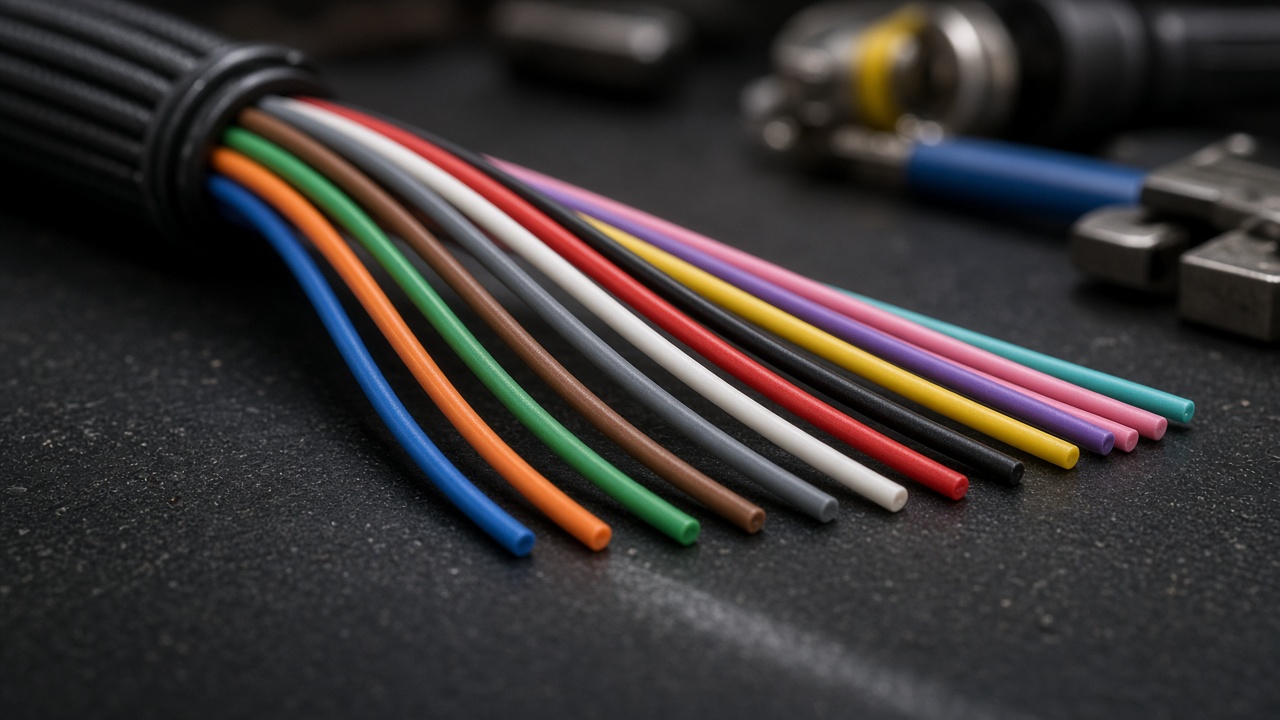
Fiber optics form the backbone of modern digital communication. Built around strands of ultra-thin glass or plastic, these cables carry data encoded in light signals, supporting everything from global internet infrastructure to enterprise-level networks and data centers. When high-speed, high-volume communication must happen across large distances, fiber optics provide unrivaled transmission efficiency, offering bandwidths that copper cables can't match.
This technology relies on the principle of total internal reflection. Inside each cable, light pulses bounce through the fiber core with minimal loss, maintaining signal clarity across dozens or even thousands of kilometers. By transmitting light instead of electrical signals, fiber optic systems drastically reduce interference, increase data security, and allow for immense bandwidth capacity.
Within this complex network, color coding plays a vital role. It identifies individual fibers, ensures proper connections, and maintains system integrity during installation, maintenance, and troubleshooting. This comprehensive guide decodes the fiber optic color code system, demystifying standards, conventions, and industry practices that keep global networks operating seamlessly.
The Role of Color Coding in Streamlining Fiber Optic Networks
Why Color Coding Matters
Color coding in fiber optics isn't decorative-it's functional. Technicians rely on it to identify fibers quickly, match connectors accurately, and ensure system continuity across thousands of individual strands. Without it, installations descend into guesswork and maintenance becomes prohibitively complex.
Each color corresponds to a specific fiber or function. For instance, the first twelve fibers in a cable follow a standardized order starting with blue, then orange, green, brown, slate, and so on. Overlooking this pattern introduces errors that compromise network performance and create costly delays during deployment.
Color Coding and Its Impact on Efficiency and Safety
Efficient fiber optic engineering depends on accurate identification. Installers use color codes to terminate cables rapidly, patch systems correctly, and ensure continuity between panels and splice enclosures. With standard color schemes, large-scale deployments, such as data centers and campus backbones, can be executed faster and maintained with fewer resources.
From a safety perspective, misidentifying a live fiber signal can result in signal loss or equipment damage. When hundreds-or thousands-of fibers are bundled together, color-coded insulation is the quickest and most reliable form of differentiation. Whether working in overhead trays or underground vaults, field technicians need to make correct connections without hesitation.
- Reduced time on site: Identifying fibers via color is exponentially faster than labeling or tracing.
- Fewer errors during splicing: Clear visual cues limit cross-connections and channel interference.
- Improved safety: Technicians can avoid testing or cutting active lines by referencing color.
The Connection Between Color Coding and Troubleshooting
Troubleshooting a faulty optical link without color coding is like navigating in the dark. Networks often span multiple buildings or route through crowded conduits, and within a single cable there may be dozens of fibers. When failures occur, tracing the faulty strand depends on two things: documentation and color sequence clarity.
Technicians use the color pattern to trace problems back to the exact fiber in a cable tray or junction box-no need to disturb neighboring connections. Diagnostics become faster, more accurate, and don't interrupt surrounding services. In systems using fusion splicing or MPO/MTP connectors, correct color orientation ensures that transmit and receive channels align correctly at both endpoints.
Have you ever seen a technician restore network service in under 30 minutes? Accurate color coding makes that outcome possible-not luck or guesswork.
Standard Fiber Optic Color Code System
Overview of the TIA/EIA-598 Color Code
The TIA/EIA-598-C standard defines the color-coding scheme for fiber optic cables used in telecommunications and networking infrastructure. Developed by the Telecommunications Industry Association (TIA), this standard streamlines identification and minimizes errors during installation and maintenance.
Under the TIA/EIA-598 standard, individual fibers are color-coded in a specific sequence for clarity and consistency. The first twelve colors establish the base for identifying fibers:
- 1 - Blue
- 2 - Orange
- 3 - Green
- 4 - Brown
- 5 - Slate (Gray)
- 6 - White
- 7 - Red
- 8 - Black
- 9 - Yellow
- 10 - Violet
- 11 - Rose (Pink)
- 12 - Aqua
Each group of 12 is repeated in the same sequence for higher fiber counts, but grouped in units such as loose tubes or ribbons. For example, a 24-fiber cable will follow two complete 12-color cycles.
Also within TIA/EIA-598 is guidance for jacket color according to fiber type. Single-mode fiber jackets are typically yellow, while multi-mode fiber jackets use orange or aqua depending on OM specifications. These visual cues reduce confusion, especially in large-scale deployments.
Importance of Following Industry Standards
Adherence to the TIA/EIA-598-C standard creates consistency across OEMs, installers, and technicians. When multiple parties participate in the same project, standardized color codes eliminate guesswork and ensure seamless interoperability.
Following this color code also improves troubleshooting speed. A technician confronting a bundle of hundreds of fibers can immediately identify their positions in the sequence without tracing back to an origin point. Over time, this shortens service windows and reduces operating costs.
When managing structured cabling across multiple locations or data centers, unified color standards allow uniform documentation, precise circuit tracking, and hassle-free upgrades. Deviating from the prescribed sequence introduces delays, particularly when changes or repairs are needed months or years later.
Have you ever traced the wrong fiber because colors weren't consistent? With TIA/EIA-598, that won't happen. Every strand belongs where the standard says it belongs-and that clarity supports every inch of uptime.
Inside the Structure: Fiber Optic Cable Construction Explained
Components of a Fiber Optic Cable
Every fiber optic cable is a multi-layered assembly engineered for speed, reliability, and protection. At the core lies the optical fiber itself - ultra-thin glass or plastic strands that carry light signals over long distances with minimal loss.
- Core: The central strand of the fiber where light travels. Single-mode cores measure around 8 to 10 micrometers in diameter, while multi-mode cores range from 50 to 62.5 micrometers.
- Cladding: Surrounds the core and reflects light back into it through total internal reflection. Its refractive index is slightly lower than that of the core.
- Buffer Coating: A protective polymer layer that absorbs shocks and prevents moisture from reaching the glass layers. Often color-coded for identification.
- Strength Members: Made of aramid yarn (commonly Kevlar), fiberglass, or steel, these materials protect the fiber from mechanical stress during installation.
- Outer Jacket: The outermost protective sheath, typically made of polyethylene (PE), polyvinyl chloride (PVC), or low-smoke zero-halogen (LSZH) for fire safety. The jacket also identifies the cable's usage through standardized colors.
In cables with multiple fibers, each individual strand may be housed in its own buffer tube or fused together in ribbons. This determines how technicians interact with fiber groups during splicing or termination.
How Color Coding is Applied in Cable Construction
Color coding appears throughout the construction, beginning with the fiber buffers and extending to the cable jackets and tubes. This hierarchy enables precise identification during installation, testing, and maintenance.
- Individual Fiber Strands: Each core is coated with a 250-micron colored buffer, following the TIA-598-C standard-using a 12-color repeating palette.
- Loose Tubes or Ribbons: When fibers are organized into buffer tubes or ribbon structures, the same color sequence applies to groups. For instance, the first tube houses fibers colored Blue to Aqua, the second repeats the sequence, and so on.
- Cable Jacket: Outer jackets adopt specific colors to indicate the fiber type: yellow for single-mode, orange for multi-mode, and aqua for laser-optimized multi-mode (OM3/OM4). These colors are not arbitrary-they match universally accepted standards that streamline field operations.
Technicians interacting with a 144-fiber loose tube cable can immediately locate the fourth aqua fiber in the seventh tube without guesswork, thanks to this meticulous color mapping. Whether dealing with high-fiber-count backbones or compact indoor jumpers, this structured application of color ensures consistency across all layers of the architecture.
Single-Mode vs. Multi-Mode Fiber Color Standards
Differentiating Single-Mode and Multi-Mode Fibers
Understanding the differences between single-mode and multi-mode fibers provides context for the distinct color coding used in each system. Single-mode fibers have a much smaller core-typically around 8 to 10 microns in diameter-and are designed for long-distance signal transmission. They carry light directly down the fiber with minimal modal dispersion, making them optimal for higher bandwidth over long distances.
In contrast, multi-mode fibers have a core diameter ranging from 50 to 62.5 microns. This larger core allows multiple modes of light to propagate simultaneously, introducing modal dispersion but simplifying alignment and connectivity. They are used primarily for shorter distance applications, such as within data centers or enterprise campuses.
The physical distinctions between these two types necessitate separate identification schemes, particularly when both are present in complex fiber networks.
Color Standards for Each Type
To enable rapid visual identification, fiber jackets follow standard color codes defined by the TIA/EIA-598-C standard:
- Single-mode (SM) fiber: These cables are color-coded yellow. This standard applies across both indoor and outdoor environments, covering OS1 and OS2 cable types.
- Multi-mode (MM) fiber, 62.5/125 µm (OM1): Jacket color is orange, commonly found in legacy systems.
- Multi-mode (MM) fiber, 50/125 µm (OM2): Also uses orange jackets but optimized for improved bandwidth.
- Multi-mode (MM) fiber, laser optimized OM3: Identified using an aqua-colored jacket. Designed for 10 GbE performance.
- Multi-mode (MM) fiber, OM4: Maintains the aqua jacket color but offers higher bandwidth and longer transmission distances than OM3.
- Multi-mode (MM) fiber, OM5: Designated by a lime green jacket, OM5 accommodates shortwave wavelength division multiplexing (SWDM) for enhanced scalability.
Interconnects and connectors also adopt keying or shrouding based on mode type to prevent mismatched connections. Yellow LC connectors typically indicate a single-mode polish, whereas beige (OM1/OM2), aqua (OM3/OM4), and green connector housings (APC versions) reflect multi-mode polish types. These identifiers extend beyond the cable sheath to every point of fiber interaction.
Whether building a point-to-point link or managing a structured fiber patch panel, identifying and understanding these color conventions ensures accurate deployment and fault-free maintenance.
12-Fiber and 24-Fiber Color Coding
Specifics of 12-Fiber Color Coding
A standard 12-fiber cable aligns with the TIA/EIA-598-D color code convention. Each individual fiber is uniquely color-coded to simplify identification, splicing, and connectorization. The color sequence follows this order:
- 1 - Blue
- 2 - Orange
- 3 - Green
- 4 - Brown
- 5 - Slate (Gray)
- 6 - White
- 7 - Red
- 8 - Black
- 9 - Yellow
- 10 - Violet
- 11 - Rose (Pink)
- 12 - Aqua
Technicians immediately recognize this pattern. In loose tube designs, each tube typically houses 12 fibers, each corresponding to one of these colors. In ribbon cables, the same pattern applies, with fibers arranged flat and in sequence, streamlining mass fusion splicing operations.
Specifics of 24-Fiber Color Coding
Doubling the count adds complexity. In a 24-fiber configuration, the same initial 12-color sequence repeats with a differentiating mark. This typically involves using fibers with the same base color but a distinct ring marking or stripe.
The most widespread implementation incorporates two 12-fiber groupings, arranged either in two separate buffer tubes, or two stacked ribbons. Here's how the color groups are managed in a 24-fiber ribbon format:
- Fibers 1-12: Standard 12-color sequence
- Fibers 13-24: Repeat of the 12-color sequence with added markings such as dashes, rings, or a different hue intensity
In ribbon cables, manufacturers may use ink-jet printed numbering or edge stripes instead of relying exclusively on color variation, especially when space is constrained.
Applications of 12-Fiber and 24-Fiber Systems
High-density data environments demand streamlined fiber organization. Both 12-fiber and 24-fiber systems serve distinct roles in network infrastructure:
- 12-fiber cables integrate seamlessly into MPO (Multi-Fiber Push-On) connector systems, predominantly in enterprise backbones, where duplex and parallel optical interconnects are standard.
- 24-fiber cables enable higher throughput by supporting 100G, 200G, and even 400G transmission using breakout configurations. Data centers employ these for trunk cables, significantly reducing pathway bulk.
Choosing between these systems often comes down to density requirements, connector architectures, and future scalability demands. Want to maximize rack space and throughput? The 24-fiber system offers superior port density and bandwidth potential. Prefer straightforward labeling and traditional configurations? The 12-fiber format keeps things simple without sacrificing capability.
Decoding Fiber Count and Color Sequences in Optical Cables
Interpreting Fiber Count in Color Coded Systems
Every fiber optic cable includes a specific number of individual fibers, referred to as the fiber count. The color coding system follows a fixed sequence that repeats based on this count. Whether dealing with a 12, 24, 48, or even 144-fiber cable, the interpretation hinges on understanding how the standard 12-color base set cycles through each group.
Take a 36-fiber cable, for instance. It uses three full sets of the 12 standard colors. Each group of twelve is called a "binder group," and although the colors repeat, each group is typically identified with additional binders or physical markers-for example, a ring marking or a second-color stripe-to prevent misidentification during splicing or termination.
A key point: the physical layout within the cable doesn't affect the color sequence. Manufacturers adhere strictly to the TIA/EIA-598 standard, meaning Blue is always fiber #1, Orange is fiber #2, and the pattern continues through Aqua (#12) before resetting with Blue for fiber #13.
Sequential Use of Colors in Larger Fiber Counts
As cable capacity increases, the complexity of tracking individual fibers escalates. Sequential color coding makes this manageable. In a 72-fiber cable, the first twelve fibers are assigned the twelve base colors:
- Blue (#1)
- Orange (#2)
- Green (#3)
- Brown (#4)
- Slate (#5)
- White (#6)
- Red (#7)
- Black (#8)
- Yellow (#9)
- Violet (#10)
- Rose (#11)
- Aqua (#12)
Fibers 13 through 24 repeat those same colors but belong to the second group. To distinguish them, manufacturers apply distinct tube colors, tracer identifiers, or ring marks. By fiber 25, the cycle begins again, creating the third binder group. This pattern repeats indefinitely according to the total fiber count.
In ribbon cables, where fibers are bonded in a flat strip, this color sequence appears across each ribbon. Each 12-fiber ribbon represents one complete cycle. So in a 288-fiber ribbon cable, there are exactly 24 ribbons-each marked sequentially using the same 12-color system to maintain accurate identification across all layers.
Feeling overwhelmed by the repetition? Ask yourself this-could you locate fiber #109 in a 144-fiber cable? (Hint: It's the first fiber in the tenth 12-color group-Blue!)
Precise Color Coding in Loose Tube and Ribbon Fiber Optic Cables
Color Coding Protocols for Loose Tube Cables
Loose tube fiber optic cables group fibers inside buffer tubes, with each tube potentially housing up to 12 fibers. Color coding in these cables follows the TIA/EIA-598-D standard, which assigns specific colors to each fiber and corresponding buffer tube. This standard ensures accurate identification and traceability across splices, terminations, and network documentation.
Here's how the color scheme plays out:
- Each fiber within a single buffer tube uses the standard 12-color sequence: Blue, Orange, Green, Brown, Slate, White, Red, Black, Yellow, Violet, Rose, and Aqua.
- When more than 12 fibers are present, another buffer tube repeats the same 12-color cycle.
- Each buffer tube is also color-coded following the same 12-color sequence to add another layer of organization.
Consider a 72-fiber loose tube cable. The cable would have six buffer tubes, each with 12 fibers. Blue buffer tube contains fibers 1-12, Orange for 13-24, Green for 25-36, and so on. This double-color sequence-tube color and fiber color-makes high-count cables scalable and traceable.
Ribbon Cable Color Codes and Organization
Ribbon cables bundle fibers in a flat matrix, usually in rows of 12, and they follow a consistent horizontal layering format. Each ribbon usually contains 12 fibers arranged in the TIA/EIA-598-D 12-color sequence. In high-density applications like data centers, manufacturers stack multiple ribbons vertically or horizontally inside a single buffer structure.
The fiber color sequence inside each ribbon remains:
- Blue (Fiber 1)
- Orange (Fiber 2)
- Green (Fiber 3)
- Brown (Fiber 4)
- Slate (Fiber 5)
- White (Fiber 6)
- Red (Fiber 7)
- Black (Fiber 8)
- Yellow (Fiber 9)
- Violet (Fiber 10)
- Rose (Fiber 11)
- Aqua (Fiber 12)
To differentiate between ribbon groups in higher count cables-such as 144, 288, or even 864 fibers-manufacturers apply ribbon identification numbers or use ink jet printing, edge striping, or colored binders. For instance, Ribbon 1 would include fibers 1 to 12, Ribbon 2 includes 13 to 24, and so on.
The organization in ribbon cables not only simplifies mass fusion splicing but also aligns with parallel optical transmission systems where precise mapping between fibers is paramount. Are you working with a high-density trunk cable and need instant identification of a 131st fiber? Using this system, it's clearly the 131 ÷ 12 = 10th ribbon (with remainder 11), meaning Violet fiber in Ribbon 11.
Smart Strategies for Memorizing the Fiber Optic Color Code
Mnemonics and Techniques
Associating colors with memorable phrases makes the 12-color fiber sequence much easier to internalize. The most widely-used mnemonic corresponds to the standard TIA/EIA-598 color code:
- Blue
- Orange
- Green
- Brown
- Slate (gray)
- White
- Red
- Black
- Yellow
- Violet
- Rose (pink)
- Aqua
Use the sentence: "Big Old Gray Buildings Should Win Races Before Your Very Rich Aunt". Each word's first letter stands for the color in order, and ties abstract fiber color sequences to more tangible imagery.
Another proven approach: group the 12 fibers by visual characteristics. For example, the first five-blue through slate-follow natural gradient tones. The next three-white, red, and black-combine highly visible base colors. The final four-yellow to aqua-lean toward brighter spectrum shades.
Training with color-coded flashcards reinforces pattern recognition. Start with single-fiber identifiers, then expand to mockup ribbon or loose tube assemblies.
Training and Educational Resources
Well-structured training accelerates mastery of fiber color codes. ANSI/TIA-598-D training modules and hands-on courses offered by organizations like FOA (Fiber Optic Association) and BICSI walk through all relevant coding standards, cable types, and real-world applications.
Many certified fiber installers rely on digital simulators and virtual labs to cycle through color code scenarios. Several apps and online quizzes provide randomized color sequence drills and timed exercises to help commit the codes to long-term memory.
In team environments, rotational quizzes or labeling competitions deepen recall through repetition and friendly challenge. Combining visual learning with kinetic engagement consistently delivers better retention rates.
Access to downloadable color code charts-from manufacturers like Corning or Panduit-also enables quick study. Print versions taped near splicing benches or termination stations offer convenient reinforcement during tasks.
Troubleshooting and Best Practices in Cable Management
Troubleshooting Using Color Codes
Color coding isn't just for convenience-it accelerates fault isolation and minimizes downtime during fiber optic troubleshooting. When multiple fibers are bundled in a cable, misidentification risks increase significantly. The standard 12-color sequence, repeated across higher fiber counts, allows technicians to identify specific strands accurately without confusion.
For example, if a 144-fiber cable fails on fiber 37, a technician immediately knows to look for the first fiber in the fourth group of twelve, which corresponds to the blue fiber in that group. This sequential patterning, once internalized, shortens diagnostic time during service calls or network audits.
Technicians track continuity and signal degradation with tools such as an Optical Time Domain Reflectometer (OTDR) or a visual fault locator. In tandem with color-coding, these instruments identify the precise strand and point of failure, particularly beneficial in high-density backbones.
Crossover issues during splicing or patch panel work often boil down to mismatched fiber pairs. Color coding eliminates guesswork-matching blue to blue, orange to orange-ensures signal integrity. During re-splice operations, color referencing reduces channel mismatch risks and avoids costly packet loss or service disruptions.
Cable Management and Organizational Best Practices
Orderly cable management begins at the design phase and evolves throughout the network's lifecycle. Structured environments prioritize color-consistent labeling, strain relief practices, and fiber routing discipline. These elements don't just enhance aesthetics-they reduce stress on connectors, lower the chance of microbends, and streamline future upgrades.
- Use labeled patch panels and enclosures: Matching fiber strand colors to well-marked ports shortens troubleshooting time and simplifies audits.
- Implement bend radius control: Maintain a minimum bend radius that complies with manufacturer specifications-usually 10 times the cable's outer diameter-to avoid signal loss.
- Adopt a vertical and horizontal pathway structure: Use cable trays for horizontal runs and ladder racks for vertical routing-keeping logic and path separation clear.
- Deploy slack management strategies: Over-length storage units or splice trays prevent kinking and stress by housing excess fiber without crowding.
- Stick to a uniform color-coding approach across departments and buildings: In enterprise environments with distributed IT infrastructure, consistency avoids critical errors.
Technicians benefit from using cable tags and barcoded sleeves, which connect physical color codes to the digital documentation of channels, routes, and endpoints. Combined with software-based asset management systems, this hybrid tracking boosts network visibility.
Routine inspections should verify that fiber units remain in their designated color positions after moves, adds, or changes. If a splice tray shows non-standard sequencing, realignment ensures that future troubleshooting remains straightforward.
Consider the impact of poor lighting in field deployments or dense racks-high-contrast color schemes and reflective labeling sharply reduce confusion under challenging visual conditions.