How Much Electricity Does a Router Use? Measure Your Network and Calculate the Cost
By RSINC editorial team | Updated
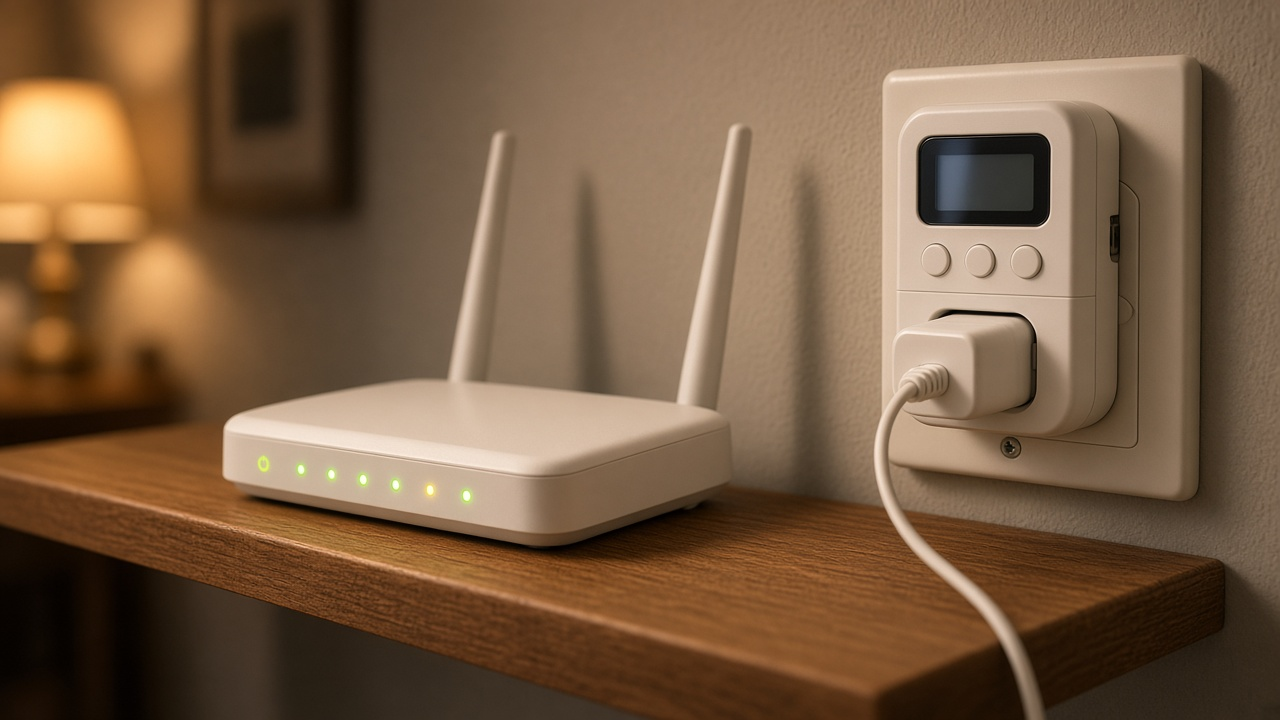
A router's electricity cost depends on its measured power draw, how long it runs and the electricity rate on your bill. There is no single wattage for every router, modem or mesh system. For an example rather than a product specification, a device averaging 10 watts around the clock uses 87.6 kilowatt-hours in a 365-day year. At an illustrative rate of $0.20 per kWh, that is $17.52 a year.
Measure the equipment you actually use
A plug-in electricity meter can help you measure a router and its power adapter together. Follow the meter's instructions and use a suitably rated device. Take a reading during normal use, or measure energy over a longer period, because a brief reading may not represent the whole day. Include a separate modem, fiber terminal, switch and each mesh node when estimating the complete network.
The power adapter's voltage and current ratings describe its electrical specifications. They do not establish that the router draws that amount continuously from the wall. Use measured consumption when available. A mesh system's number of nodes alone also cannot establish its wattage.
Calculate annual energy and cost
For a constant average load, annual kWh equals average watts multiplied by hours per day and days per year, divided by 1,000. Multiply the result by your applicable per-kWh rate to estimate the energy charge. Fixed charges on the bill generally remain even if you reduce consumption; time-of-use rates require a calculation for the hours involved.
| Illustrative average load, running 24 hours daily | Annual energy, 365 days | Cost at an example $0.20/kWh |
|---|---|---|
| 5 watts | 43.8 kWh | $8.76 |
| 10 watts | 87.6 kWh | $17.52 |
| 20 watts | 175.2 kWh | $35.04 |
| 30 watts across several devices | 262.8 kWh | $52.56 |
These rows are calculation examples, not typical wattage claims for particular Wi-Fi generations, gateways or brands. Replace both the load and the electricity rate with your own figures.
What could switching off overnight save?
In the same 10-watt example, switching the device off for eight hours every night reduces running time by 2,920 hours a year. That represents 29.2 kWh, or $5.84 at the example rate, before accounting for any other equipment. Savings depend on what is actually switched off.
Consider devices that need an overnight connection before changing the schedule. A router's Wi-Fi schedule may switch off its wireless radios while the rest of the device continues operating; it is not automatically equivalent to removing all power. Our guide to turning Wi-Fi off at night discusses the practical trade-offs.
Keep equipment and service costs separate
Removing an unnecessary network device may reduce power use, but check that the remaining equipment can perform its job. Compare a replacement's purchase cost with measured savings before buying it for energy savings alone. For satellite equipment, use the specific modem and dish documentation rather than applying a Wi-Fi router example to the whole system. See our Viasat modem power guide.
If you compare internet plans, a ZIP search is an initial screen. Confirm your exact address, equipment requirements and the full written offer before ordering.
For help comparing internet at your address, call RSINC at 1-877-697-2926 or compare local providers.
Reviewed November 4, 2026. Availability, prices and terms can change.